Friday, March 2, 2012

Chapter 25: New Imperialism

1. The later 19th and start of the 20th century saw the explosion of many European nations spreading their countries' boundaries throughout the world; hardly any part of the world was left untouched by European influence. These imperialistic ideals were enforced strongest in China and Africa. The land in these two countries was so prized to the European nations attempting to spread their financial influence throughout the world that they even went as far as making pacts as how to divide up these chunks of land.
During the time of imperialism, the Great Migration took place. The Great Migration spread many people throughout the world essentially spreading the culture throughout the world as well. This when the United States gained the large portion of immigrants that they are extremely well-known for.

Chapter Objective: Explain the causes of imperialism and understand the reactions of the countries affected by this movement.

EQ: What were the main causes of the new imperialism and why?

This new imperialism was caused by the need to extend a country's financial boundaries, the belief that it was the white man's duty, or their "burden", to help the "uncivilized" and lesser beings of other countries to better their lives and the belief that God wished for one's country's expansion. These three causes, commonly summarized as, "Christianity, Civilization and Commerce", are considered the main causes behind the imperialism of the late 19th/ early 20th century.

2.
 This cartoon shows an octopus-like creature grabbing any country that it can get its hands on. This is extremely similar to Britain and the actions it took during the 19th and 20th century when spreading its boundaries. The artist seems to disapprove of the actions Britain took. I get the feeling the the cartoon has this "Britain is getting its grubby little paws on everything" feel. The countries closer to the head of Britain, which look to be the Netherlands and Ireland, look almost like they are being sunk by Britain as well. I don't agree or disagree with what Britain did. I agree with them spreading their boundaries to be stronger, for the term survival of the fittest could always apply to countries as it can people; the stronger and bigger a country is, the longer it will survive. Yet, I disagree with the methods that Britain took over countries. There is always a more peaceful approach to things, and England never even gave that a thought.

 This image is showing the "mad scramble for Africa" by many European countries. All of the significant powers of Europe are pulling on the tarp that is Africa to try and get it for themselves. The characters are pulling at the parts of Africa that their respective countries actually controlled during the push for Africa. At the southern tip of the country, the Boers and British are fighting for control of the area that they both want. David Bainbridge, the artist of the cartoon, has given it a negative connotation. The leaders and significant players of each country are acting greedy by yanking on the edges of the country that they want for themselves. It almost looks like they are going to tear apart the country if they do not let up on their actions. Bainbridge has a point with this image. These European countries did essentially "tear apart" the country. There was fighting from the natives because they did not was these foreigners invading their home. The push for the country did not need to be so forceful and rough, but with the was history works that would never be the case.

3.
This is pretty self-explanatory is its meaning. The image to the left is showing the United States flag wrapping itself around the world as if it were about to control it like it were its own. One could also say it was blanketing the world in some sort of protection; that would be dependent on a person's perspective on whether the United States' is imperialistic or not. If I were to guess, I would say the artist was inferring the United States was a monster plaguing the world. The red stripes look almost like tentacles wrapping around Earth. I would have to agree with the author; only to a certain extent. I do not agree with all the actions taken by our country to get involved into the politics of nearly all the countries in need, but again, sometimes aid IS needed.

4. Do you think the United States is/has been imperialistic? Give three reasons pro and three reasons con.
Pros
  • This imperialistic mindset made
    the United States a powerful country
    very quickly
  • Matthew Perry and his method
    of gunboat diplomacy forced
    Japan to open up their country
    to foreign trade
  • The boundaries of the United
    States expanded to larger spaces
    within the world and in the manner
    so did their influence
Cons
  • Taking control of such a good portion
    of the world has left the United States
    in a significant amount of debt
  • The ways that the United States gained
    support to expand was
    wrong when looked back on now
  • Not every other country believes the United
    States influence is for the best interest of
    everyone
5. 
During this period in time, the United States decided to involve itself it the building of the Panama Canal. But, when this treaty was signed by the United States and Panama it was an ambassador of France to Panama which caused some problem for the U.S. These were not the only problems for the Americans when building the canal though. When the workers were working on the canal itself, many died from yellow fever and malaria. This American investment in Panama is very similar to European investments in other countries during the 19th and 20th centuries.

On a more social note, the first movie ever created in the United States - Fred Ott's Sneeze, was created in 1889. The entire motion picture is shown at the left. The film only lasted 5 seconds and was produced by Thomas Edison and his company. Just a year before that, another film entitled Roundhay Garden Scene was filmed in England. This film lasted but 2.11 seconds. It's apparent that this scene influenced the recording of Mr. Ott's sneeze, which started off the worldwide phenomena that is modern-day cinema.


6.
Great Rebellion/Sepoy Mutiny
Textbook Definition: The 1857 & 1858 insurrection by Muslim and Hindu mercenaries in the British army that spread throughout northern & central India before finally being crushed (May 10th, 1857).
  • Was called a mutiny by the British
  • The main cause of the mutiny was because of new cartridges  used by British guns
    • Covered in animal fat which one would have to bite off in order to fire their guns
      • This went against their religion
  •  Their uprising was quelled fairly quickly, before they could get anywhere significant with it
  • Last attempt at India independence until actual Indian independence
 

7. 
Egyptian Revolution (January 25th, 2011)

TIMELINE OF KEY DEVELOPMENTS

Tuesday, 1/25: First Day Of Demonstrations
Wednesday, 1/26: Protests Resume For Second Day
Thursday, 1/27: Egypt Shuts Down The Internet
Friday, 1/28: Mubarak Speaks, Says He'll Form A New Government
Saturday, 1/29: Anonymous Internet Users Help Egypt Communicate
Sunday, 1/30: Hillary Clinton: Egypt Must Transition To Democracy
Monday, 1/31: Egypt's New Government Is Announced, Sworn In
Tuesday, 2/1: President Mubarak Says He Won't Run For Re-Election
Wednesday, 2/2: Internet Service Returns In Egypt
Thursday, 2/3: Foreign Journalists Rounded Up
Friday, 2/4: "Day of Departure" Protests Held Across Egypt
Saturday, 2/5: Members Of Ruling Party Leadership Resign
Sunday, 2/6: Government Agrees On Concessions
Monday, 2/7: Google Executive Released In Egypt
Tuesday, 2/8: Freed Activist Energizes Protests
Wednesday, 2/9: Widespread Labor Strikes Throughout Egypt
Thursday, 2/10: Despite Rumors, Mubarak Refuses To Step Down
Friday, 2/11: Mubarak Resigns As President; Leaves Cairo

Key Players of the Revolution:

President Hosni Mubarak

 V.P. Omar Suleiman
 
Mohamad El Baradei
 
How & Why?: Inspired by the success in Tunisia, Egyptians took the street against uncontrollable unemployment, poverty, and corruption fueled by autocratic rule. After weeks of forceful protests, the Egyptians finally got a change in rule. Considering whether the revolution was a success, one could say yes. It still seems like the country is in the rebuilding stage as the government is under control by a military republic.

8.

Spotlight On... The Suez Canal!
"The Highway to India"

 This artificial canal is extremely important in the movement of goods across the world by water. This body of water connects the Mediterranean and the Red Sea. By using the Suez Canal, ships save significant amounts of time traveling long distances around Earth. The canal is currently under the control of Egypt; more specifically owned and taken care of by the Suez Canal Authority. The Suez Canal serves the same purpose as the Panama Canal; it allows ships to pass through land without traveling much longer distances around continents. The one major difference between the Suez and Panama Canals is that the Suez Canal contains no locks and the Panama Canal does.

9.
 
     3. 
  •  I learned that Africa was divided up into "pieces" between many different countries.
  •  Imperialistic thoughts are still prominent in today's world; they're just shown in different ways.
  •  The main reasons behind new imperialism were "Christianity, Civilization and Commerce".
     2.
  • Japan did not really open up to the rest of the world until just recently in history.
  • The amount of imperialist nations that there was during this period was astonishing. There was so many people fighting for limited land.
     1.
  • The British were "given" Hong Kong after the First Opium War, but how did it get back into the control of the Chinese - if it ever did?

Sunday, February 5, 2012

Ideologies and Upheavals

1.
Introduction:
Chapter 22: Ideologies and Upheavals fixates on the dual revolution of politics paired with industrial progress. Vigorous forces from the strongest nations in Europe meet within the Congress of Vienna and Klemens von Metternich of Austria appears as the most influential of all leaders. The Congress and the Balance of Power used to maintain the, well, balance of power between the nations is very effective until new political and social beliefs come into play. These beliefs - socialism, nationalism, and liberalism; lead to an increase in political tension within European countries. During the advancements in politics, their was also a social movement of individual freedom and personal expression called romanticism. The Potato Famine destroyed the Irish population because they were so dependent on the potato as a crop.

Chapter Objective:
Understand who the important people were politically and socially, and why. Relate their impact(s) to modern day society and legislation.

Essential Question:
Who were the main influences of this time period and why were they so important to the continued growth of European culture?

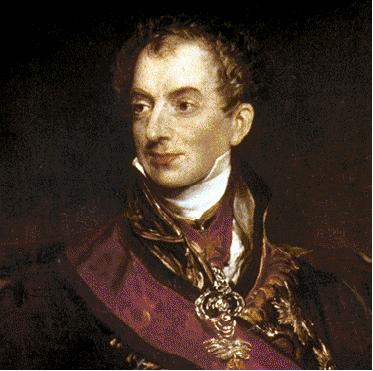
Klemens von Metternich - Minister of Austria who became the front-runner for conservatism during the Congress of Vienna.

Karl Marx - Writer of the Communist Manifesto and "founder" of communism itself.

William Wordsworth - English writer who was the leader of romanticism within England. He was influenced greatly by Rousseau and the French Revolution.

Eugene Delacroix - Considered the "one of the greatest and most moving" romantic painters in France. His most famous work is his painting Liberty Leading the People.

Ludwig van Beethoven - Considered the "first great romantic composer". Beethoven's compositions were so magnificent that they are just as, if not more, well-known today as they were back in his time.

Louis XVIII - Ruler of France. Issued a Constitutional Charter (liberal constitution) that made great gains for the middle class and peasantry, allowed for fantastic intellectual and artistic freedom and created a Parliament with two houses. But, this charter still only allowed for the wealthiest of males to vote.

Charles X - Successor to Louis. Led a force of 37,000 men across the Algiers to take the capital of Algeria. Repudiated the Constitutional Charter, stripped wealthy middle class of voting rights, and censored the press. He was overthrown in "three glorious days".

Louis Philippe - Ruler after Charles fled. Accepted Constitutional Charter and adopted the modern day red, white and blue flag of the French Revolution. He considered himself the "king of the French people" but did nothing measurable to prove as such.

2.
      Eugene Delacroix


Eugene Delacroix was a French Romantic artist who was regarded as one of the best, if not THE best Romantic artist to ever exist. His form of painting laid the groundwork for many of the modern-day impressionists and various other painting styles. His subjects, mainly the most exotic and outrageous things possible, influenced the artists and sculptures of the Symbolist movement in the late Nineteenth century. Delacroix held a strong identification with the "forces of the sublime" - the moments of nature during violence and it's utmost action-packed peak.


 Ludwig van Beethoven
Beethoven was a German composer and pianist. He was an extremely important part of the Romantic era of Western Art Music. He is, in the opinions of many people, the most famous and influential of all composers. During the peak of his fame, Beethoven's hearing began to slowly fade away. Even with this handicap, he continued to compose, conduct and perform to the best of his ability. Many had high opinions of Beethoven, one man said "Beethoven's music sets in motion the lever of fear, of awe, of horror, of suffering, and awakens just that infinite longing which is the sense of Romanticism."


     Klemens von Metternich
Metternich was an Austrian- born German politician and one of the most important diplomats to ever come from Austria. During his lifetime, he served in the Congress of Vienna and as the Foreign Minister of the Holy Roman Empire. His strict belief in conservatism led to his declaration of the Carlsbad Decrees. These decrees ordered the 38 German states to uphold Metternich's conservatism and root out all liberal organizations and subversive ideas that could possibly overthrow Metternich and his beliefs.


3.
       Missouri Compromise
The Missouri Compromise was an agreement passed in 1820, with the help of president James Monroe, between the anti-slavery and pro-slavery portions of the United States of America. It prohibited slavery in the former Louisiana Territory above the 36th parallel except within the boundaries of Missouri. This allowed the people of Missouri to draft their own Constitution and form their government. Maine was admitted into the Union as a free state and Missouri was admitted into the Confederacy as a slave state.
       Monroe Doctrine


Named after president James Monroe, The Monroe Doctrine is a policy that, in essence, officially gave all land in the United States to the Americans. This policy stated that any further efforts by Europeans nations to colonize or interfere with North or South America would be seen as an act off aggression requiring immediate United States intervention. It stated that America would not interfere with already existing European colonies. When Monroe stated this during his 7th annual State of the Union Address to Congress, it because the definition of American foreign policy.


4.
Picturing the Past:
This Painting by Joseph Turner titled The Wreck of the Minotaur depicts everything that Turner stands for. The ocean viciously tears apart the once beautiful ship without remorse. Turner showed the terror of nature within all of his paintings. Particularly in this painting there are many methods his depicts his terror. The broken part of the ship to the back right looks a lot like a monster of sorts; the dark, plain colors themselves give off a sense of hopelessness.

Analyzing the Image: In what other ways does Turner depict nature as a terrifying force? Is there anyway(s) one might take the painting and see safety rather than fear?

Connections: How is nature depicted in modern day society? Explain.

5.

3 Things I Learned

  • Liberalism, socialism, and nationalism were the main reasons for the tension brought forth in government(s)
  • The Great Famine was a main influence for Irish immigration to America
  • Romanticism is a reaction to the Enlightenment; emotion and self is more important that logic and reason
2 Things I Found Interesting

  • George Sand was, in fact, just the alias of a woman
  • Beethoven was actually deaf - I just thought that was a myth
1 Question I Still Have
  • Why was it that just after there was a magnificent industrial advancement (complete opposite of nature), people debate, artistically, the significance of nature?